Time is the most merciless recorder. As history’s wheel crosses into the fourth anniversary of the Russia-Ukraine conflict, this military operation initially predicted by some to last only tens of hours has evolved into the largest and most brutal war of attrition on the European continent since World War II. Today we mark a highly symbolic milestone: 1,461 days since the outbreak of full-scale conflict. Four full years have passed, yet air raid sirens still echo over the night sky of Kyiv, and trench warfare on the Donbas plains remains deadlocked. The nature of the war has undergone earth-shaking changes over these four years—from the initial armored blitzkrieg to aerial swarm drone combat, and now to long-range precision strikes spanning thousands of kilometers. At this critical juncture connecting past and future, it is necessary to strip away the ostentation of diplomatic rhetoric and the fragments of online information, and re-examine this burning land through a purely military lens and a sober strategic perspective. In today’s article, we will provide a panoramic review of the real strategic picture as the war enters its fifth year, covering multiple dimensions: the latest breakthroughs on the frontlines, severe shocks in Russia’s strategic rear, the fundamental reshaping of European defense concepts, and the undercurrents of great power rivalry.
Chapter One: From Passive Defense to Dimensional Reduction Strikes: Ukraine’s Southern Counteroffensive and Deep-Penetration Raids
Although international attention has recently focused largely on the tug-of-war at various peace negotiation tables, the smoke of battle has never ceased for a moment on the actual physical battlefield. At the beginning of this anniversary week, the Armed Forces of Ukraine demonstrated with concrete actions that they still firmly hold a certain degree of initiative on the battlefield, exhibiting a high degree of flexibility in tactical execution.
First, let’s look at the latest breakthrough on the southern front. The President of Ukraine officially announced in recent public remarks that the Ukrainian Defense Forces successfully conducted a sharp counterattack on the southern defensive line, liberating over 300 square kilometers of occupied territory in one stroke. This achievement has been corroborated by multiple authoritative independent military think tanks, including the American Institute for the Study of War (ISW). From a tactical level analysis, the success of this counteroffensive was no accident. Open-source intelligence indicates that Ukrainian forces advanced particularly rapidly in the border area between Dnipropetrovsk and Zaporizhzhia oblasts, successfully breaking through Russian defensive lines east of Novoprokopivka and achieving substantive progress southeast of Oleksandrivka, with settlements including Orestivka brought back under Ukrainian control. The victory in this local campaign keenly exploited a fatal vulnerability in the Russian military’s command and communication network. Due to recent technical measures by SpaceX to widely block Starlink terminals illegally obtained and used by Russian forces on the front lines, the broadband data links between Russian frontline tactical units and rear command posts were instantly paralyzed. In modern information warfare, troops deprived of high-speed data link support are akin to beasts losing sight and hearing. Ukrainian frontline commanders seized with extreme precision the brief window when Russian command was thrown into chaos and drone coordinated combat capabilities were significantly degraded, decisively committing mobile forces to execute this swift penetration and encirclement operation.
If we shift our gaze from the southern plains to Russia’s strategic rear, the long-range strike capability demonstrated by the Ukrainian military is equally astonishing. The military action that most shocked the world this week was undoubtedly Ukraine’s precise long-range strike on the Votkinsk Machine-Building Plant in Russia. This factory is by no means an ordinary arms facility; it is one of Russia’s most core strategic missile production bases. The short-range ballistic missiles, such as the “Iskander” which have been a major headache for Ukrainian forces on the front lines, and the RS-24 “Yars” intercontinental ballistic missiles capable of carrying nuclear warheads and reaching the North American continent, all roll off this plant’s assembly lines. The General Staff of the Armed Forces of Ukraine confirmed that this operation used the Ukrainian-developed “Flamingo” land-based cruise missile. What must be emphasized here is the spatial span of this strike: the Votkinsk plant is over 1,400 kilometers from the Russia-Ukraine border. In military science, a cruise missile successfully flying 1,400 kilometers and hitting a high-value strategic target signifies that it must have perfectly planned its route, utilized terrain-masking effects, flown at extremely low altitudes throughout, and successfully evaded the layered radar search of Russia’s S-300 and S-400 air defense missile systems deployed on its territory. This reflects that Ukraine’s guidance systems, terrain-matching technology, and electronic countermeasure capabilities for cruise missiles have reached world-class levels. This missile struck not just a factory workshop, but also the sense of security within Russia’s strategic defense system. It sent an extremely clear signal to the Kremlin: no Russian defense industry facility enjoys absolute safety immunity within the range of Ukraine’s long-range firepower projection.
Simultaneously, Belgorod, a Russian city near the border, was again subjected to a large-scale missile attack, severely damaging urban infrastructure and causing widespread disruptions to power, water supply, and heating systems. The Moscow region was also unsettled, with dozens of Ukrainian suicide drones targeting the Russian capital, forcing the emergency closure of all four major airports in the Moscow area. Closing the capital’s airports carries an extremely high economic cost and an immeasurable political price for any major power. This indicates Ukraine has mastered an asymmetric warfare model that directly transmits the real pain of war to the political and economic heartland of Russia.
Furthermore, in the occupied Zaporizhzhia and Kherson regions, Ukrainian long-range artillery and drone units executed a high-intensity precision “acupoint” strike campaign over the weekend. A drone command post near Zlatopil, a logistics transfer warehouse in Bohdanivka, and an equipment repair base in Rozivka were all subjected to devastating strikes. This systematic destruction of Russian logistical nodes and command centers is gradually eroding the material foundation sustaining high-intensity combat operations on the front lines.
Chapter Two: Scorched Earth in the Winter Cold: Infrastructure Strangulation and Sabotage in the Shadows
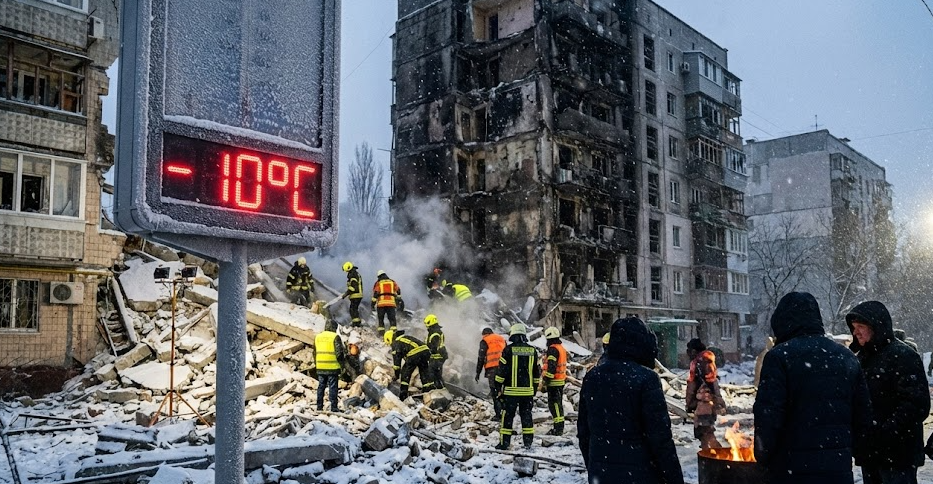
War is never merciful. In Russian military doctrine, attacking enemy civilian morale and destroying the support systems for the normal functioning of enemy society hold strategic importance equal to eliminating enemy combat forces on the front lines. At the beginning of this anniversary week, the Russian military continued its brutal “Winter Energy Strangulation” strategy. The current average temperature across Ukraine hovers around -10°C. In this bone-chilling cold, Russian missiles and drones have locked their sights onto Ukraine’s power plants, substations, and heating networks.
At 4 AM Sunday, Kyiv’s tranquility was shattered by violent explosions. Continuous air raid alerts lasted until 8 AM. A Russian ballistic missile, with extremely high terminal penetration speed, struck a multi-story residential building, instantly igniting a towering inferno. Rescue workers dug desperately through the highly dangerous rubble, eventually saving eight survivors but also confirming the death of one civilian. On the same night, Odesa and Sumy were also attacked by mixed formations of missiles and drones. This attack pattern typically uses cheap drones as decoys to deplete Ukrainian air defense missile stocks and expose radar positions, followed by a fatal strike from high-value cruise or ballistic missiles. In these attacks, apartment buildings, warehouses, energy substations, and even a school suffered varying degrees of damage, with at least fifteen civilians injured. In Kherson, a Russian drone even directly attacked a civilian minibus, injuring three people including the 71-year-old driver.
Beyond the overt bombing from the skies, a more covert and sinister shadow war is quietly spreading through Ukraine’s rear-area cities. Over the weekend, the historic western Ukrainian city of Lviv experienced an extremely vicious series of explosions. The method of this incident bore the hallmarks of terrorism. The attackers first placed a homemade explosive device in a trash can in the old city. When police arrived at the scene to investigate following a reported “break-in alarm,” the device detonated. As more support police arrived to treat the wounded, a second, more powerful bomb hidden nearby exploded. This carefully laid ambush targeting law enforcement resulted in the tragic death of a 23-year-old female police officer, Victoria Spilka, who had just gotten married last autumn, and injured dozens more. Ukraine’s Minister of Internal Affairs subsequently issued a strongly worded statement, indicating there is substantial intelligence evidence that this crime was orchestrated and directed by Russian intelligence agencies. This reflects that Russia, frustrated on the conventional battlefield, is increasingly resorting to “hybrid warfare” tactics. Through the dark web or social media platforms, using financial enticements, intimidation, and threats, they recruit unstable individuals within Ukraine—even some vulnerable civilians—to create panic, assassinate public officials, and disrupt social order in major cities far from the front lines. This invisible front poses an extremely severe challenge to the preventive capabilities of Ukraine’s internal security agencies.
Chapter Three: Europe’s Fundamental Awakening: From Hesitant Bystander to the Leap Toward Defense Autonomy
Pulling our perspective back from the smoke-filled battlefield to the political decision-making centers of the West, this four-year bloodbath has acted as a powerful catalyst, fundamentally altering the geopolitical map of Europe and its defense psychology. Once upon a time, European political elites were accustomed to discussing economic integration while enjoying comfortable “peace dividends,” entrusting the heavy burden of security and defense to the United States across the ocean. When the war first broke out, the initial reaction of many European leaders was shock and helplessness, with some pessimistically believing Ukraine would be completely overrun within days. At the time, the German government’s proposal to send 5,000 helmets to Ukraine remains a classic footnote illustrating Europe’s early lack of crisis awareness.
However, four years later, the air in Brussels is filled with a distinctly different sense of solemnity and resolve. European politicians have formed an unquestionable consensus: Ukrainians are using their own blood as a physical buffer zone defending all of Europe against Russian military expansion. This understanding is no longer a small-scale private discussion but an open strategy on the table. Diplomats openly point out that if Russian armored columns were not stopped on the banks of the Dnipro River, the Baltic states would inevitably become the next target. This survival-crisis-based bottom-line thinking has driven the EU to undertake a series of strategic leaps unimaginable before the war.
First is the disruptive change in the logic of EU enlargement. Before the war, due to complex interest entanglements and strict accession criteria, Ukraine’s path to EU membership was seen as a long, almost endless dead end. The EU even designed various “neighborhood partnership” frameworks attempting to keep Ukraine permanently outside the core circle. Now, these artificially erected barriers have been shattered by the hammer of war. Ukraine eventually becoming a full EU member state is now a widespread expectation in Brussels. Advancing this process will not only completely alter Europe’s economic map but also trigger seismic shifts in political decision-making mechanisms. A Ukraine with a large population size and strong military potential joining the EU would significantly change the internal power balance and could even foster deep alliances between Poland and Ukraine on various issues.
Second is the comprehensive reshaping of Europe’s own defense philosophy and military-industrial system. Faced with the war’s immense consumption and increasing uncertainty regarding US transatlantic security commitments, Europe is truly examining the urgency of “strategic autonomy.” We see the EU’s defense expenditure budget growing at a staggering rate, with member states pushing joint weapons procurement and defense industrial expansion with unprecedented intensity. The European Commission has even begun formal preparations to procure weapons and equipment suitable for operations in polar and severe cold conditions—a direct response to security threats on the northern flank. European actions may sometimes seem sluggish and cumbersome; its mechanisms are like a massive supertanker requiring immense time to change course. But once this tanker completes its course correction, the immense industrial energy and capital momentum it contains will generate overwhelming force. Just as it reacted slowly initially to the COVID-19 pandemic but ultimately became the world’s largest vaccine exporter, Europe is striving to replicate the same industrial mobilization capacity in the realm of military defense.
Chapter Four: Returning to “Day One”: Judgments and Choices at 10 Downing Street
To understand the current strategic landscape more profoundly, we need to rewind the clock to the first day of the war and explore the key decisions made at that historical turning point. The UK’s Chief Foreign Affairs Commentator, David Blair, recalling that world-changing day, provided an invaluable insider’s perspective. At that time, despite accurate warnings from British and American intelligence agencies about Russia’s invasion plans, at the moment full-scale conflict erupted, a deep-seated pessimism pervaded the entire European leadership and their top advisors. The prevailing consensus was: facing Russia’s vast military machine, Ukrainian resistance would be brief and futile, Kyiv would fall swiftly, and Ukraine’s legitimate government would be completely overthrown. A leader from a major European country even privately expressed despair at the time that within the next few days, or even hours, a free Ukraine would cease to exist.
In that overwhelming atmosphere of pessimism, then-British Prime Minister Boris Johnson displayed exceptionally rare strategic intuition and political courage. He firmly believed that Putin had made the most disastrous strategic miscalculation of his life and was convinced that Ukrainians possessed the will and capability to resist to the end. Subsequent battlefield developments proved this judgment prescient. Russia’s operational plans revealed staggering levels of chaos and inefficiency during execution; armored columns advancing on Kyiv and Kharkiv became bogged down in severe logistical disasters and layered Ukrainian defenses. Ukrainian President Volodymyr Zelenskyy’s refusal of a Western-offered evacuation flight, choosing instead to stay on the streets of Kyiv, became the strongest rallying cry for the nation’s will to resist. When the Ukrainian military demonstrated through action that they were not only willing to fight but could effectively inflict casualties on Russian forces, Europe’s psychological defensive line was fully activated.
Here, a historically decisive move by the UK before the war must be mentioned. Just one month before the invasion, the UK, resisting various pressures, publicly airlifted over 2,000 NLAW (Next Generation Light Anti-tank Weapon) systems to Ukraine. At the time, many nations were still waiting and seeing., fearing that supplying lethal weapons would provoke Russia. When the war began, journalists on the front lines witnessed the terrifying destructive power of these British-supplied anti-tank missiles in the hands of Ukrainian soldiers. In the forests and road intersections around Kyiv, once-formidable Russian main battle tanks were easily torn apart by the NLAW’s top-attack mode, turning into burning scrap metal. These tangible results sent an extremely clear signal to the entire Western world: arming Ukraine was not supporting a doomed guerrilla war, but providing the tools of victory to a nation capable of defending its own sovereignty. It was based on this understanding that the political floodgates for European countries to provide heavy weaponry truly opened.
Chapter Five: Diplomatic Quagmire and Great Power Rivalry: Undercurrents of Interest Exchange
Beyond the artillery fire on the battlefield, the cut-and-thrust in the diplomatic arena is equally intense, sometimes appearing even more unpredictable. On this fourth anniversary, rumors about peace negotiations are swirling again. The United States is attempting to accelerate the push for some form of ceasefire agreement, with some media reports suggesting Washington has even set a hoped-for timeline to end the conflict by summer. Behind this urgency lie profound domestic political calculations in the US—the upcoming midterm elections require a foreign policy “achievement” to present to domestic voters. However, this approach of seeking an agreement for agreement’s sake has sparked deep anxiety in Ukraine and Europe.
Russia’s negotiation tactics are extremely cunning. They are adept at exploiting Western politicians’ desire for economic benefits and war-weariness by offering various highly tempting but perilous schemes. For example, intercepted information by Ukrainian intelligence indicates Russia attempted to pitch a massive economic cooperation plan to the US, dubbed the “Dmitry Plan,” trying to lure the business-interests-focused White House into compromising on Ukrainian territorial sovereignty with promised long-term economic benefits worth tens of trillions of dollars. Faced with this strategy of division, Ukrainian President Volodymyr Zelenskyy issued his sternest warning to NATO allies. He clearly drew a red line: Kyiv would absolutely reject any bilateral agreement reached among major powers behind Ukraine’s back, if its terms demanded territorial concessions from Ukraine or violated the Ukrainian constitution.
Simultaneously, American diplomatic envoys handling the extremely complex geopolitics of Eastern Europe have exposed a worrying lack of professional expertise. During a closed-door briefing, a senior US envoy could not even correctly state the specific year the full-scale conflict began, even absurdly claiming the war had lasted longer than World War II (which began in 1939 and lasted six years). This staggering ignorance of basic historical facts and the war’s timeline has caused a serious crisis of confidence among European allies regarding Washington’s ability to lead negotiations.
Within Europe, fissures are equally clear. Hungarian Prime Minister Viktor Orbán continues to play the role of the most unstable variable within the EU. As Hungary’s domestic elections approach in April, Orbán faces the most severe public opinion challenge of his 16-year rule. To salvage his election prospects, he has not hesitated to play the cards of “populism” and “nationalism,” even extremely defining Ukraine as an “enemy” in public speeches. The Hungarian government has repeatedly used its veto power to attempt to block or delay the EU’s massive €90 billion aid loan package for Ukraine, using it as leverage to extort the unfreezing of EU funds from Brussels. Orbán’s strategy is clear: consolidate his base by stoking fear among conservative voters in non-urban areas that “Ukraine joining the EU will drain funds belonging to Hungary” and that “aiding Ukraine will drag Hungary into war.” This act of holding Europe’s collective security interests hostage to a single leader’s electoral calculations is severely eroding the EU’s political credibility.
Chapter Six: The Hidden Trojan Horse: Russia’s “Shadow Network” in Europe
If the Ukrainian front lines are the meat grinder of conventional war, the entire European continent has become the vast battlefield for the “hybrid war” waged by Russia. A report jointly issued by senior intelligence officials from multiple countries reveals a chilling truth: Russian intelligence agencies (such as the FSB and GRU) are weaving a vast and covert sabotage network across European countries. One of the core methods of this network is exploiting legal grey areas and complex shell companies to acquire sensitive real estate in at least a dozen European countries on a large scale. These meticulously selected properties are often located adjacent to core military bases, critical infrastructure hubs, or important government communication nodes in various European nations. These seemingly legitimate private properties are, in fact, “Trojan horses” placed in the heart of Europe. They are used as signal interception stations, safe houses for undercover illegal agents, and even storage depots for supplies for future physical sabotage operations.
Western intelligence agencies point out that since the war’s outbreak in 2022, European countries have jointly expelled over 600 Russian intelligence operatives operating under diplomatic cover. This unprecedented counter-espionage operation did deal a heavy blow to Russia’s high-level intelligence network in Europe. However, Russia’s tactics have rapidly shifted in an alarming direction. They no longer rely solely on highly trained senior spies but have begun heavily recruiting so-called “single-use agents.” These individuals might be criminals, extremists, or mercenaries recruited from the fringes of European society. They have no official background and may not even know who their ultimate employer is. They are directed to carry out low-level sabotage activities across Europe, such as arson attacks on defense industry warehouses, creating chaos at transportation hubs, or even using commercial drones for illegal reconnaissance over military restricted zones. While these operations lack sophistication, their goal is not to gather strategic intelligence but to sow widespread panic and fatigue within European societies, thereby weakening the political will of European populations to support Ukraine. This is a low-cost but extremely insidious attrition tactic.
Chapter Seven: The Leader’s Burden and the Nation’s Choice: Kyiv at the Crossroads
At the center of this storm stands Ukrainian President Volodymyr Zelenskyy. Looking back over these four years, Zelenskyy has undergone a historic transformation—from a political novice to a wartime commander fearlessly defending his nation’s dignity before the world. His choice at the war’s outset not only saved Ukraine but also, to a large extent, salvaged the moral baseline of the Western world. However, as the war enters its fifth year, the pressure he bears has reached unimaginable extremes.
On one hand, he must continuously rally the nation’s will to resist amidst mounting frontline casualties, repeated destruction of domestic infrastructure, and rising war fatigue among the populace. On the other hand, he must perform an incredibly dangerous high-wire act on the international stage: confronting the immense “peace promotion” pressure from the new US administration driven by domestic political interests, striving to maintain the cohesion of Europe’s inherently loose alliance, and remaining vigilant against every verbal trap Russia lays on the negotiation table.
In recent public opinion polls, while an overwhelming majority of Ukrainians still place high trust in the president who led them through the darkest hour, complex emotions have also emerged. People yearn for peace and rebuilding their lives, but absolutely cannot accept a humiliating truce bought with the cession of their ancestral lands. Zelenskyy finds himself in a painfully difficult strategic paradox: some Western allies, and even factions within certain European countries, have begun privately considering “land for peace” as an acceptable default option; but for Kyiv, yielding on this core principle would not only betray the hundreds of thousands of military and civilian casualties but also legally legitimize the aggression, planting an even more destructive time bomb for Ukraine’s future. If he insists on no compromise, he risks the catastrophic rupture of external aid; if he is forced to accept compromise, he may trigger uncontrollable political turmoil domestically. This is the cross a wartime national leader must bear.
Conclusion
The long night persists; the flames of war have not ceased. Over four years, Ukraine has forged itself into a premier military power on the European continent in terms of combat operationalization. With almost no large surface vessels, they have driven the Russian Black Sea Fleet from Sevastopol using unmanned vehicles and shore-based missiles; lacking air superiority, they have constructed an extremely resilient air defense interception network; after suffering unimaginable human and material losses, they have still pinned down one of the world’s largest armies along the front lines. These are military achievements that border on the miraculous.
However, the war’s ultimate trajectory depends not solely on the bravery of frontline soldiers. It depends even more on the maneuvering among major powers, the sustained operation of industrial production capacity, and humanity’s adherence to justice and fundamental principles. Entering the fifth year, there is no possibility of a swift victory in this war. It will continue to test the blood and will of Ukrainians, the wallets and resolve of Europeans, and the principles and resilience of the entire international system. In this world of variables, the only certainty is this: peace is never something to be begged for; it must be defended with strength and won with wisdom.