
In January 2026, the Trump administration controversially asserted a claim for “sovereign access rights” to US military bases in Greenland. The Danish Prime Minister immediately countered, stating that sovereignty is an “insurmountable red line.” This openly provocative dispute among allies served as a stark wake-up call, heightening global awareness of the Arctic. In March of the previous year, Russian President Vladimir Putin personally visited the Murmansk naval base to inspect the new nuclear-powered submarine “Arkhangelsk” and attended the Arctic Route Development Forum, declaring the icy region Russia’s “strategic lifeline.”
As global warming accelerates, sea ice extent has shrunk by 27% over the past five years. The former “frozen禁区” is rapidly transforming into navigable waterways and resource goldmines. A cargo ship sailing from Shanghai to Rotterdam via the Arctic route, for instance, could reduce journey distance by 30% and save 40% on fuel. While this presents an economic opportunity, it has also sparked military competition among major powers. From Russia’s “ice fortress” to America’s “forceful return,” the Arctic is no longer a tranquil “end of the world” but a perilous frontier of contention.
The Arctic’s Strategic Awakening
The dramatic changes in the Arctic stem from climate warming. Data from the US National Snow and Ice Data Center shows unprecedented sea ice melt, exposing oil and gas resources estimated at 13% of the world’s undiscovered oil and 30% of its natural gas, along with nearly 30% of its rare earth mineral deposits. These resources fuel the ambitions of nations. More importantly, the navigational value is transformative: the extended opening periods of the Northern Sea Route and the Northwest Passage will fundamentally reshape Eurasian trade patterns.
Russia’s Arctic region, with less than 1.3% of its population, contributes 15% of its GDP and 25% of its exports, accounting for 20% of its oil and 75% of its natural gas extraction. Over the past five years, Russia has invested heavily, allocating $17.5 billion to build shipyards, ports, and railways, aiming to boost Northern Sea Route cargo traffic to 150 million tons by 2030.
From a military perspective, the Arctic is a “lethal shortcut” in global strategy. Intercontinental ballistic missiles and strategic bombers traversing the Arctic Ocean can directly strike major Northern Hemisphere powers. It is also a critical location for missile early warning; controlling the Arctic means holding a chokehold over deterrence capabilities.
Looking back, this Arctic rivalry spans three centuries. From the era of Peter the Great, Russia used expeditions like Bering’s to map Siberia and discover Alaska, laying groundwork for expansion. The 20th century saw the Arctic fully militarized during the Cold War. In 1926, the Soviet Union claimed vast Arctic territories. In 2007, a Russian submarine planted a flag on the Arctic seabed, a move Western nations decried as the “start of a new Cold War.” Now, as the ice recedes, the Arctic is transitioning from a “shared global commons” to a “private domain of major powers,” with nations accelerating their strategic positioning.
Russia’s Fortress and America’s Return with Ambition
As the country with the longest Arctic coastline, Russia has long been constructing its “ice fortress.” Since 2005, Russia has reopened dozens of Soviet-era military bases, weaving a deep defense network on the Novaya Zemlya and Kola Peninsula. Novaya Zemlya, once a nuclear test site, was where Russia test-launched the “Burevestnik” nuclear-powered cruise missile in October 2025. The Kola Peninsula houses two-thirds of Russia’s secondary nuclear strike force and hosts the headquarters of its Northern Fleet, which commands half of its strategic nuclear submarines. Russia views securing the Barents Sea route to the Atlantic as a national lifeline, employing the “bastion defense” concept by deploying air defense missiles, nuclear submarines, and Arctic forces to ensure the security of its sea-based nuclear deterrent.
The United States was once a relatively passive observer in the Arctic, allowing its post-Cold War infrastructure to age, leaving it with only two aging icebreakers. However, in recent years, the US has made a forceful return, revealing clear ambitions. Since 2013, the US has issued multiple Arctic strategy documents, and by 2024, its “Arctic Strategy” explicitly designated the Arctic as a core national security interest. Alaska serves as a US military hub, with eight bases hosting 22,000 troops, F-22 and F-35 fighters, and ground-based interceptors at Fort Greely. Pituffik Space Base (formerly Thule Air Base) in Greenland is a key forward early-warning installation for missile warning and space tracking. The Trump administration’s 2026 gambit for “access rights” in Greenland aimed precisely to strengthen this strategic stronghold. The US is also advancing icebreaker upgrades and a network of LC-130 “Ski-Bird” transport aircraft, training over 5,000 personnel annually for extreme cold-weather operations.
Other Arctic nations, including Canada and Denmark, are also intensifying their efforts. Canada is procuring over-the-horizon radar, expected operational by 2028, to monitor polar air traffic. Its Alert base is the northernmost permanently inhabited location globally, specializing in signals intelligence. Denmark’s “Sirius” dog-sled patrol conducts reconnaissance in Greenland, supported by a 150-person contingent at the Joint Arctic Command. Iceland, while having no standing military, hosts Keflavik Air Base as a key hub for rotating US P-8A Poseidon aircraft. Norway, acting as NATO’s “gatekeeper,” is reactivating Cold War underground facilities like Bardufoss Air Station, using mountain tunnels to shelter F-35s and submarines, providing protection against nuclear strikes.
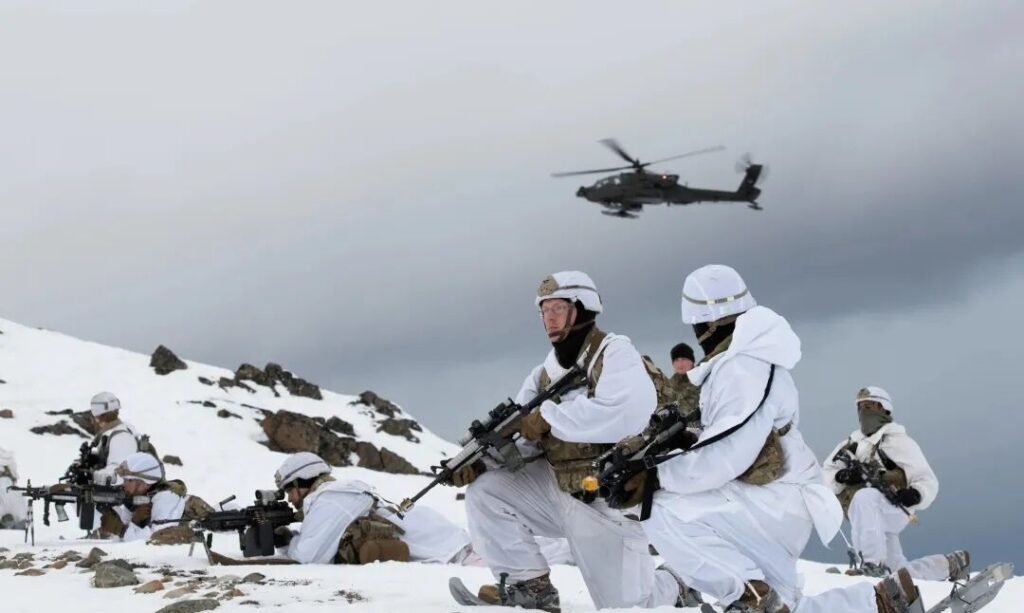
A Life-or-Death Struggle Between Technology and Nature
The true adversary in the Arctic competition is not just rival nations but also the unforgiving natural environment. This harsh region, with temperatures plummeting to -70°C, can cripple even the most advanced equipment instantly. During a joint military exercise in Northern Canada involving seven nations earlier this year, US all-terrain vehicles failed after just half an hour in the extreme cold, with hydraulic fluid solidifying. Swedish night vision goggle casings cracked at -40°F, rendering optics useless. The extreme cold fundamentally alters material properties: rubber hardens and leaks, moisture turns to ice acting like a blade damaging pumps, and PVC cables become brittle and snap like glass. Lubricants thicken to a syrup-like consistency, potentially causing aircraft malfunctions or missiles to jam. Power supply and communications present even greater challenges. A Swedish battery charging unit weighed 400 pounds, making transport through deep snow nearly impossible.
Drones and AI, effective on battlefields like Ukraine, collectively fail in the Arctic. Battery life plummets, and strong winds and icing increase risks for drones. AI systems lack sufficient data sources for real-time analysis. While beautiful, auroras disrupt radio and satellite signals.
Prompted by government needs, some high-tech companies are beginning to tackle these military-specific challenges. For example, the UK-based company “Arctic Research and Development” simulates environments as cold as -94°F to test its “Icelink” communication nodes. In the Arctic, the nation that first solves the critical problems related to materials, energy, and communication will gain a decisive advantage.
US-Russia Confrontation in the Polar Region: A New Cold War?
US-Russia antagonism forms the main axis of the Arctic rivalry. The US 2024 strategy identifies Russia as the primary threat, with bombers and aircraft carriers deployed on a regular basis. Russia has responded forcefully, establishing specialized Arctic forces and intensifying training as outlined in its “Arctic Policy through 2035.”
Following Finland and Sweden’s accession to NATO, the alliance’s northern flank has consolidated. Finland’s Rovaniemi Air Base hosts Jaeger Brigade units, and Sweden’s Luleå-Kallax Air Base serves as a transit point for US bombers. Among the eight members of the Arctic Council, seven are NATO nations besides Russia, creating a “seven versus one” dynamic.
The militarization of the Arctic is accelerating, with increased exercises and frequent incidents of interference, raising the risk of sliding towards a “new Cold War.” However, nations also recognize the high cost of excessive competition. The international community needs to establish crisis communication mechanisms and promote cooperation in scientific research and search and rescue. China can seize opportunities, adhere to a win-win approach, enhance its voice through economic collaboration, and simultaneously strengthen its polar capabilities.
The Arctic should not become a new frontline for conflict but rather a high ground for shared human coexistence. Major powers must transcend the inertia of expansion and seek sustainable development pathways. Otherwise, this icy region could transform from a treasure trove into an unpredictable source of instability, threatening global security.