
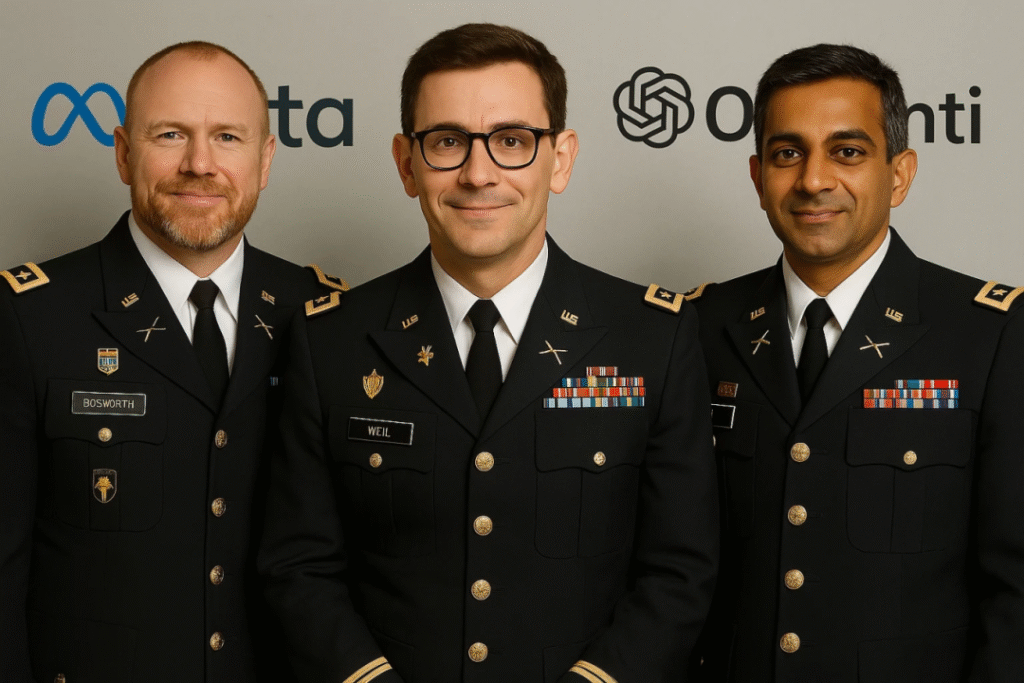
In 2025, the US Army Reserve’s “Unit 201” recruited four top Silicon Valley tech executives, directly commissioning them with the rank of Lieutenant Colonel without requiring participation in traditional basic training. They serve approximately 120 hours annually via remote asynchronous work, focusing on providing commercial technology adaptation solutions for Army transformation and promoting the implementation of “dual-use” technologies. This has become a landmark event in the US military’s deep integration with Silicon Valley’s technological resources to accelerate military intelligent transformation.
I. Real-World Motivations Behind Executive Military Service
National Security and Strategic Competition Drivers. Currently, emerging technologies such as artificial intelligence are significantly impacting the nature of warfare, prompting the US military to accelerate its intelligent transformation. To address technological competitive pressure from countries including China and Russia, the US military urgently needs top tech talent to enhance combat effectiveness in key areas such as AI, cybersecurity, and big data. Silicon Valley executives directly participate in strategic-level AI projects through military service, aiming to shorten technology development cycles through deep civil-military integration and ensure dominance in next-generation warfare.
Deep Civil-Military Integration Drivers. The US military is advancing its “Army Transformation Plan,” urgently requiring cutting-edge civilian technologies such as AI, big data, and distributed systems to replace obsolete equipment and enhance intelligent combat capabilities. Traditional in-house military development cycles are long and costly, struggling to match the iteration speed of commercial technology, necessitating direct introduction of Silicon Valley’s “innovation gene.” Silicon Valley elites possess core technologies including AI and large models, and their companies have long served the US military. Through direct military service, this model meets both their “technological patriotism” and commercial interest alignment needs.
Personal Value and Career Opportunity Expansion. For Silicon Valley elites, military service offers a unique opportunity to apply technological capabilities in high-impact scenarios. By joining innovative units like Unit 201, they can directly participate in shaping future warfare rules while bypassing traditional lengthy military promotion paths. This identity shift satisfies some tech leaders’ national security concerns while enabling them to play greater roles in cutting-edge fields such as AI ethics and military decision-making, achieving resonance between personal values and national strategy.
II. Practical Benefits of Executive Military Service
Unit 201’s operational mechanism essentially represents “precise grafting of military requirements onto Silicon Valley technology.” Through a top-level directly controlled flat structure, it achieves rapid alignment of technical requirements and decisions, ensuring swift conversion of commercial technology into military capabilities.
Efficient Command Chain. The unit’s core feature is “bypassing intermediate levels to directly connect with the Army’s highest command level,” directly commanded by the Army Chief of Staff, with the Army Secretary coordinating resources. This forms a short-chain command model of “Chief of Staff decision – Unit execution – Military department implementation,” avoiding the procedural redundancy of traditional military units and ensuring technical proposals from Silicon Valley executives enter the Army’s decision-making purview rapidly. For example, the AI anti-drone system development they promoted completed the process from proposal to military project approval in just three months, shortening the timeline by over 60% compared to traditional projects. Simultaneously, the unit has built a tripartite external coordination network integrating “military – tech companies – defense firms,” directly connecting with military agencies including the Army Transformation Office and the Defense Department’s Chief Digital and AI Office to clarify technical requirements and procurement standards, while coordinating with core companies like Meta, OpenAI, and Palantir to open channels for commercial technology military conversion.
Flexible Talent Management. The unit does not use traditional military recruitment processes but prioritizes top executives with “technological influence” in cutting-edge fields such as AI, big data, and VR, using “scarcity in core technical areas” as the primary selection criterion. The four current executives were all directly commissioned as Army Reserve Lieutenant Colonels, an exceptionally rare promotion in US Army history, reflecting the military’s high regard for technical talent. Unlike traditional reservists, Unit 201 members use a “remote asynchronous work” model, serving only about 120 hours annually, equivalent to one weekend per month plus two weeks per year, ensuring substantial technical support to the military without excessive disruption to their corporate work.
Rapid Conversion Cycle. Unit 201’s core mission is promoting the conversion of Silicon Valley commercial technology into military capabilities. Its task execution process forms a closed loop around “requirement alignment – technology development – testing implementation – iterative optimization,” emphasizing “rapid response, precise adaptation, and combat orientation.” Task initiation relies on a “top-down + bottom-up” requirement alignment mechanism. After task initiation, the unit establishes a special team, holds 1-2 alignment meetings with the requester to clarify technical indicator implementation timelines and acceptance criteria, and forms a “Technical Conversion Task Document” to prevent disconnection between technology development and military requirements. The technology development phase adopts a collaborative model of “military proposing requirements, companies providing technology, unit coordinating,” leveraging Silicon Valley companies’ technical reserves and agile development experience for rapid iteration. After technology development completion, it enters the “testing – acceptance – deployment” phase, focusing on combat scenario validation to ensure technology adapts to battlefield environments.
III. Strategic Impact of Executive Military Service
Unit 201’s establishment represents a core element of the US military’s response to major power technological competition and promotion of military strategic transformation. Its strategic impact permeates multiple dimensions including military affairs, technology, and defense industry, profoundly rewriting the underlying logic of modern military force development.
Accelerating US Military Intelligent Combat System Transformation. Army Chief of Staff General Randy George explicitly stated that the unit’s establishment aims to “accelerate the pace and drive the Army’s transformation into a leaner, more intelligent, and more lethal force.” With deep integration of AI algorithms and unmanned platforms, the US military may rapidly form human-machine mixed units, realizing new combat formations such as “loyal wingman” and “unmanned vehicle swarms,” accelerating warfare’s evolution toward “intelligent and unmanned” forms. The big data analysis and AI-assisted decision-making technologies promoted by the unit are changing US military strategic decision-making models. By integrating multi-dimensional data including global battlefield data, geopolitical information, and weapons performance, AI decision systems can provide senior leadership with precise strategic predictions and proposals, enabling coordinated multi-domain force deployment and enhancing US military’s all-domain combat command capabilities.
Reshaping Global Military Technology Competition Landscape. Unit 201’s establishment aims to establish US military first-mover advantage in intelligent military domains. Currently, through projects promoted by the unit, the US military has formed clear leads in areas including AI military applications, intelligent unmanned platforms, and digital battlefield construction, further widening the technological gap with other countries. This US military move forces other major powers to accelerate military intelligent transformation, triggering a new round of military technology competition. Russia has increased investment in AI military applications, focusing on intelligent unmanned combat vehicles and AI command systems. China promotes conversion of commercial AI and big data technologies into military domains through civil-military integration strategy, focusing on technological breakthroughs in intelligent combat platforms and cybersecurity. Additionally, countries including the UK, France, and Japan are emulating the US military model, attempting to attract tech company talent and accelerate military technology innovation. The global military technology competition’s focus has shifted from traditional weapons to core elements including “algorithms, data, and computing power.”
Triggering Strategic Ethical Controversies. First, the ethical dilemma of autonomous weapon systems: AI weapons development promoted by the unit equips weapons with certain autonomous decision-making capabilities. Critics worry that if AI systems are granted combat decision-making authority over life and death, algorithmic bias or system malfunctions could lead to misjudgments causing大量 civilian casualties, violating humanitarian principles. Second, conflict of interest and technology abuse risks: it is difficult to completely prevent these executives from using military resources to benefit their companies, leading to unfair competition in defense procurement or technology abuse. Finally, exacerbating digital battlefield security threats: the US military’s intelligent military capabilities could also be exploited by terrorist organizations or extremist groups through hacking or technology theft to obtain AI military technology, increasing global security threats.